“The hard work and dedication of the brilliant scientists at Caltech have advanced our dream of providing the world with abundant, reliable, and affordable power for the benefit of all humankind.” — Donald Bren
A new documentary film highlights the ongoing efforts and breakthroughs of three Caltech professors in their quest to make space-based solar power a reality. In 2011, philanthropist Donald Bren provided a generous grant to Caltech which began the Space-based Solar Power Project. In 2023, the project, led by professors Harry Atwater, Ali Hajimiri, and Sergio Pellegrino launched the Space Solar Power Demonstrator into orbit, showcasing three technological advancements needed to make space-based solar power possible.
The Bright Harvest website details the story behind the Caltech Space-based Solar Power Project, along with ways to view the documentary.
Here’s a summary of “Astroelectricity: America’s national energy security imperative” by Mike Snead (The Space Review, September 22, 2025). You can read the full article here. Learn more about Mike at The Spacefaring InstituteTMhere.
Conclusions
Snead argues that space solar power–supplied astroelectricity is the only sustainable energy solution that is both large enough and practicable enough to enable America to replace its fossil carbon energy sources before depletion and avoid returning to energy insecurity. The scale of the energy transition is enormous, and only with strong government leadership, research, and early deployment of SSP can the U.S. ensure an orderly transition. To maintain national energy security, and protect future generations, Snead believes the development and deployment of astroelectricity must now be viewed as a strategic imperative.
Main Points
The U.S. currently depends heavily on fossil fuels: oil, natural gas, and coal supply about 70–80 Quads of the ~100 Quads of primary energy consumption as of 2019.
Technically recoverable oil and gas in the U.S. may last ~75 years at 2019 consumption levels, but with exports and growing use, the lifetime could be much shorter.
To transition (“go clean”) to sustainable energy, two criteria are key: (1) sufficient scale, and (2) a practicable, orderly implementation. Political or symbolic solutions will not suffice.
Of all sustainable energy sources, only a few are scalable to entirely replace fossil carbon fuels: intermittent wind, intermittent ground solar, baseload nuclear fission, and baseload space solar power (SSP), i.e. “astroelectricity.”
Assessment of wind power: Even if large areas are used, in average years wind might supply ~68 % of the needed intermittent power; in low wind years that drops sharply; public/land-use acceptance is a major constraint.
Ground solar farms: To meet the intermittent power need would require ~14 % of the U.S. contiguous land area—much of which overlaps with prime agriculture or unsuited terrain.
Nuclear fission: To supply all baseload power would require many times current nuclear capacity; breeder reactors bring proliferation risks; decommissioning, waste, natural disasters, and terrorism risks also loom large.
Astroelectricity (SSP): Collect sunlight in geostationary orbit, convert to electricity, beam to earth via radio/microwave, received by large rectenna farms. Supplies baseload power. Requires only a small fraction of U.S. land compared to terrestrial-only options.
For example: to supply ~80 % of baseload power via astroelectricity, about 4,339 GW continuous (GWc) would be needed from SSP, requiring ~182,000 km² land for rectenna/plant sites—< 3 % of the contiguous U.S. land area.
Glossary of Terms Used
BTU (British Thermal Unit) A unit of thermal energy defined as the amount of heat needed to raise one pound of water by one degree Fahrenheit. 1 BTU ≈ 1,055 joules. Used to measure the energy content of fuels like coal, oil, and natural gas.
BOE (Barrel of Oil Equivalent) A unit that expresses energy content in terms of a barrel of crude oil. One BOE = 5.8 million BTU of thermal energy. Useful for comparing different fuels on a common basis.
Quad (Quadrillion BTUs) A large-scale unit of energy equal to 1 quadrillion (10^15) BTUs. Commonly used to describe national energy consumption. For example, in 2019, the U.S. used about 100 Quads of primary energy.
GW (Gigawatt) A measure of power equal to 1 billion watts (10^9 W). Often used to describe the size of power plants or electricity generation capacity.
GWc (Gigawatts Continuous) A refinement of GW, meaning gigawatts of continuous power output, i.e., power delivered around the clock without interruption. Used to describe baseload capacity requirements for astroelectricity.
Technically Recoverable Resources The portion of identified oil, gas, or coal reserves that can be produced with existing technology and practices, regardless of market price.
Primary Energy Energy found in natural resources (like coal, oil, natural gas, wind, sunlight) before being converted into electricity, fuels, or heat for use by consumers.
Baseload Power The minimum level of continuous power demand that must be met by an energy system. Technologies that can deliver baseload (like nuclear or space solar power) are especially valuable for energy security.
Rectenna A large ground-based receiving antenna that converts microwave or radio wave transmissions from space solar power satellites back into usable electricity.
On August 14, 2025, I joined a SpaceNews live webinar on space-based solar power (SBSP). This panel discussion brought together some of the most experienced voices in the SBSP field.
Over the course of an hour, the panel made a compelling case that SBSP, once the stuff of science fiction, is now within reach, thanks to dramatic drops in launch costs, advances in mass production, and maturing in-space assembly capabilities. They explored different technical pathways, financing and regulatory hurdles, and the enormous humanitarian and economic potential of delivering clean, 24/7 energy from space to anywhere on Earth.
I believe the moment for space-based solar power has truly arrived. With bold action from all of us, we can help light the way to a cleaner, more resilient planet. – Rob Mahan
You can watch the entire event here. I have summarized the panelist’s main points below.
Event Summary
SpaceNews hosted a live webinar on August 14, 2025, moderated by Jason Rainbow, featuring four prominent voices in the space-based solar power (SBSP) field:
John Mankins – Mankins Space Technology, SPS-Alpha inventor
Martin Soltau – Space Solar (UK)
Colby Carrier – Aetherflux
Karen Jones – The Aerospace Corporation
The discussion highlighted why SBSP is closer to reality than ever: dramatic launch cost reductions, advances in mass production, and maturing in-space assembly. The panelists explored competing architectures (microwave vs. laser), early market opportunities, financing challenges, safety/regulatory issues, and the transformative global potential of 24/7 clean power from space.
Main Points by Panelist
John Mankins
Why Now: Reusable rockets have dropped launch costs from ~$20,000/kg to potentially under $100/kg; mass production of space hardware is now <$1,000/kg.
SPS-Alpha Concept: Hyper-modular geostationary platform made of over 1 million small modules; uses proven solar, reflector, and microwave transmission technology. No new physics is required.
Regulatory Notes: Microwaves need spectrum allocation via ITU; lasers pose eye safety and siting concerns.
Humanitarian Potential: One satellite can beam power to wealthy regions, and within seconds, be switched to beaming power to developing regions, providing disaster relief and energy equity.
Martin Soltau
Economics & Orbits: High-orbit systems offer highest utilization for grid-scale power but require billions in early investment; financing roadmap is as critical as technology.
Global Need: Energy demand may quadruple in 25 years; weather-dependent renewables face mineral, cost, and land limitations. SBSP offers low carbon footprint, high scalability, and affordability.
Early Markets: Polar research stations, remote islands, data centers, off-grid industry, and underserved communities.
Public Support: Strong once safety and siting are explained; SBSP is seen as vital to reliable, abundant, clean energy.
Colby Carrier
Aetherflux Strategy: Low Earth Orbit (LEO) laser-based constellation targeting military needs for dispersed, resilient, mobile power.
Laser Advantages: Small, precise beams for portable receivers; harder for adversaries to target; suits rapidly redeployed ground forces.
Safety Measures: Laser safety officer on Aetherflux staff; beam cutoff systems; early regulator engagement.
Karen Jones
Market Landscape:
Solution Providers – Focused on space-to-Earth SBSP (e.g., Aetherflux).
Incrementalists – Start with space-to-space power beaming to build capability.
Skeptics/Competitors – Advocate other energy tech but may become SBSP partners.
Safety & Public Trust: Microwaves at proposed wavelengths are non-ionizing; but public concerns must be addressed head-on, as the cellular phone industry did.
Spectrum Constraint: Allocation will shape future architectures.
Additional Insights
Financing is the bottleneck, not the physics. Starship could cut deployment launches from hundreds to a dozen, slashing energy costs by >10x.
Resilience: Hyper-modular designs can survive damage; constellations of modules can scatter like schools of fish, complicating attacks.
Dual Use Concerns: RF systems are inherently difficult to weaponize due to low energy density designs; all platforms will be highly visible and open to international inspection.
Public Action: Panelists encouraged citizens to press investors, pension funds, and elected officials to support SBSP initiatives.
Space-based solar power is no longer an abstract concept tucked away in research papers—it’s a tangible solution within our grasp. The technology is ready, the need is urgent, and the benefits are global. What we lack is the unified will to make it happen. If each of us, citizens, innovators, investors, and policymakers, speaks up, demands progress, and supports the pioneers in this field, we can accelerate the shift from vision to reality. The sunlight is already waiting above us, streaming down in abundance. It’s time we reached up, captured it, and shared its power with the world.
This recent Space and Things podcast featuring John Mankins is an excellent all-around introduction to space based solar power (SBSP) and its game changing, clean energy potential.
For those who may not be familiar, John C. Mankins is a former NASA physicist known for his ongoing work on space-based solar power. Along with explaining the fundamental of SBSP in easy-to-understand language, Mankins made a point I would like to highlight.
Unlike nuclear power plants, SBSP will be a switchable baseload power source. SBSP will be able to take the place of natural gas and other fossil fuel fired generation now being used to supplement terrestrial solar and wind power when nighttime or weather interrupt their outputs. The combination of space-based and terrestrial solar power will be a 100% clean, baseload power source.
Mankins also had some astute observations about the most recent NASA report on SBSP, published on January 11, 2024 from the Office of Technology, Policy, and Strategy.
Energy for Earth is not one of NASA’s four current missions
The report has a very reasonable charter at the beginning.
The analyses contained in the report utilize excellent, rigorous methodologies.
The report has some extraordinarily reasonable findings and recommendations at the end.
But … the assumptions that went into that model were weird. The assumptions were unreasonably pessimistic, leading to astronomically high predictions of the cost per kWh from SBSP.
There is a one-line caveat included in the report that says if all of our assumptions turn out better than we have assumed, the cost of a kWh from SBSP will be about three cents.
Needless to say, you should read the report for yourself (linked above) and come to your own conclusions about its assumptions, charter, analyses, findings, and recommendations. Keep in mind the fact that energy for Earth is not one of NASA’s four current missions.
Ariel Ekblaw, PhD, is the Co-Founder and CEO of the Aurelia Institute. Her MIT PhD and continuing research in autonomously self-assembling space structures is primarily directed at the construction of human-rated space habitats. This developing technology can also help to meet the ecological and energy challenges currently facing our planet.
“We’re working to see if we can help start-up energy companies assemble thousands of solar panels in orbit, above the atmosphere.” – Dr. Ariel Ekblaw
I was excited to learn that Dr. Ekblaw has long been a supporter of space-based solar power (SBSP), which she discusses at 6:47 of the TED Talk above. The technology of autonomously self-assembling space structures is a critical component of making SBSP an economically viable clean energy source for humankind.
Headquartered in Troy, Michigan, Virtus Solis was founded by John Bucknell and Dr. Edward Tate. Together, the founders have deep experience in heavy launch and propulsion technologies, as well as the analysis and development of energy systems.
The Virtus Solis website makes a bold claim about the space-based solar power (SBSP) technology they have developed:
Virtus Solis is the world’s first space-based solar power energy generation system able to directly compete with conventional and renewable energy sources with none of the drawbacks.
As outlined in the video above, some notable features of the Virtus Solis SBSP technology include:
Use of commercial, reusable heavy launch provider
Massive and highly scalable arrays of satellite solar collectors
Use of the highly elliptical Molniya orbit between low-earth and geosynchronous orbital altitudes (MEO)
Found in the National Space Society’s (NSS) Space Solar Power Library, the Survey of Space Based Solar Power, Virtus Solis, 2024, written by John Bucknell, includes detailed descriptions of several proposed SBSP architectures including the Virtus Solis’ Lucidus Hyper-Modular Architecture (2023). This SBSP survey reaches the following conclusion:
As shown, most SBSP systems described herein could provide energy at a competitive price in today’s market and future markets. The Virtus Solis architecture excels, with an LCOE of $25/MWh.
I entered the following query into the Gemini Deep Research AI:
What is the current state of space-based solar power development and what entities are currently conducting research on space-based solar power development? Compile a list of the top ten entities which are likely to accomplish the development and deployment of space-based solar power on a commercial scale?
Gemini rewrote my query as:
Provide an overview of the current progress in space-based solar power (SBSP) development, identify organizations currently researching SBSP, and list the top ten entities most likely to achieve commercial-scale SBSP deployment.
Following is the report that Gemini Deep Research developed in about ten minutes after researching and analyzing data from hundreds of websites. I’ve included the Executive Summary and Conclusion and Future Outlook for SBSP in full, with headings for the remaining sections of the report.
Space-Based Solar Power: Progress, Key Players, and the Path to Commercialization
I. Executive Summary
Space-based solar power (SBSP), the concept of harvesting solar energy in space and wirelessly transmitting it to Earth, is experiencing a significant resurgence of interest driven by advancements in space technology and the pressing need for clean, reliable energy. Recent milestones, such as Caltech’s successful wireless power transmission from space and Space Solar’s demonstration of 360° power beaming, highlight the tangible progress being made. A diverse range of organizations, spanning government agencies like NASA, ESA, JAXA, and AFRL, academic institutions such as Caltech and Kyoto University, and private companies ranging from established aerospace giants like Northrop Grumman and Airbus to innovative startups like Space Solar and Aetherflux, are actively engaged in research and development efforts. While significant challenges remain, particularly in terms of cost-effectiveness and large-scale deployment, the potential of SBSP to provide continuous, baseload power is attracting increasing attention and investment. This report provides an overview of the current state of SBSP development, identifies the key organizations involved, and analyzes the top ten entities most likely to achieve commercial-scale deployment in this transformative field.
II. Introduction: The Promise of Space-Based Solar Power
III. Current Landscape of SBSP Development
IV. Leading Organizations in SBSP Research and Development
V. Key Private Sector Players in the SBSP Arena
VI. Technological Advancements and Key Challenges in SBSP
VII. Evaluating the Potential for Commercial-Scale Deployment
VIII. Top Ten Entities Most Likely to Achieve Commercial-Scale SBSP Deployment
IX. Conclusion and Future Outlook for SBSP
Space-based solar power stands at an exciting juncture. The convergence of technological advancements, particularly in space launch and wireless power transmission, coupled with the ever-increasing global demand for clean energy, has propelled SBSP from a futuristic concept towards a tangible possibility. Recent demonstrations and the growing number of active players across government, academia, and the private sector underscore the significant momentum in this field.
While considerable challenges remain, particularly in achieving cost-effectiveness and deploying large-scale systems in space, the long-term potential of SBSP to provide continuous, baseload power is undeniable. The projected growth of the SBSP market indicates increasing investment and a shift towards more development-focused initiatives. The next decade will likely see significant progress in technology maturation and further in-space demonstrations, paving the way for pilot projects and, eventually, commercial-scale deployments.
The entities identified in this report, with their diverse strengths and approaches, are at the forefront of this endeavor. Their continued progress, coupled with sustained government support and further technological breakthroughs, will be crucial in realizing the promise of space-based solar power and its potential to revolutionize the global energy landscape. As the world continues to strive for a sustainable energy future, SBSP is poised to play an increasingly important role, offering a clean, reliable, and virtually limitless source of power from the ultimate energy provider – the Sun.
I have long held that the full implementation of space-based solar power (SBSP) will depend on the development of off-Earth construction capabilities and the utilization of off-Earth material resources. The deep gravity well of our home planet makes placing Earth-sourced and manufactured SBSP components in orbit almost prohibitively expensive, although recent advances in reusable launch vehicles is driving that cost curve down.
As NASA plans for long-term human exploration of the Moon under Artemis, new technologies are required to meet the unique challenges of living and working on another world.
In late 2022, ICON, a 3D printed housing company based in Texas, received a contract under NASA’s Small Business Innovation Research (SBIR) program to continue its research and development of lunar-based construction systems. Project Olympus will aim space-based construction systems to support planned exploration of the Moon, Mars and beyond.
“To change the space exploration paradigm from ‘there and back again’ to ‘there to stay,’ we’re going to need robust, resilient, and broadly capable systems that can use the local resources of the Moon and other planetary bodies. We’re pleased that our research and engineering to-date has demonstrated that such systems are indeed possible, and we look forward to now making that possibility a reality.”
Jason Ballard, ICON co-founder and CEO
Project Olympus will be the first significant off-Earth, largely autonomous construction project utilizing locally sourced materials. While not building solar panel arrays or wireless power transmission structures, the habitats, launch facilities, and other support structures that Project Olympus will hopefully create will be critical to establishing a persistent human presence on another world.
Perhaps an SBSP solar panel array manufacturing facility on the Moon should be on NASA and ICON’s short list of things to build out of lunar regolith next!
After listening to Can Science Save Us?, a conversation with Sir Martin Rees on the Michael Schermer Show, I wrote both Dr. Schermer and Lord Rees with the intention of telling them about space-based solar power (SBSP), which was not mentioned in the podcast. As a result, I was invited to write an article about SBSP for the current issue of Skeptic Magazine v28.2: Energy Matters. My article, ‘It’s Always Sunny in Space,’ is reprinted here with permission from Skeptic Magazine.
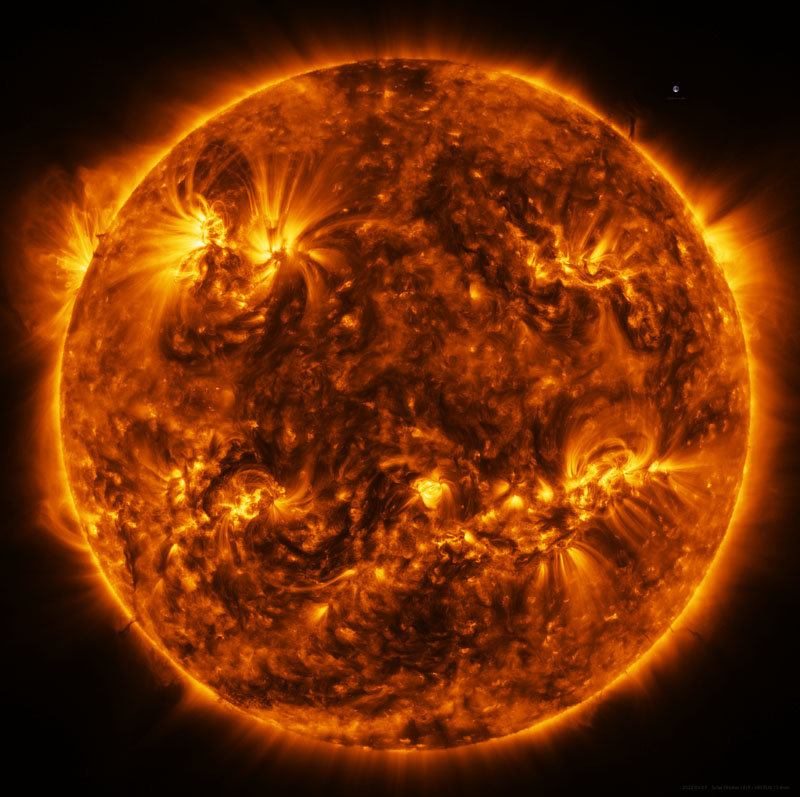
This is the highest resolution image of the Sun’s full disc and outer atmosphere (the corona) ever taken, as seen by Solar Orbiter in extreme ultraviolet light from a distance of nearly 47 million miles. This stellar image is a mosaic of 25 photographs taken on March 7, 2022 by the high resolution telescope of the Extreme Ultraviolet Imager (EUI) instrument. An image of Earth is included for scale, in the upper right corner of the illustration.
A tremendous thermonuclear furnace, our Sun radiates about 134,000 terawatts (TW) of continuous power to Earth’s surface, about 7000 times more than the entire population of humankind consumes from all current sources of energy.
It’s Always Sunny in Space
Why space-based solar power is a viable source of energy.
by Rob Mahan
Advances in human civilization have always been fueled by the availability of excess energy in various forms. For the vast span of human history, energy from the Sun was converted to food and biomass by photosynthesis and expended in the forms of muscle power and fire. Energy from the Sun produced weather, and as a result, wind- and water power were eventually harnessed and converted into increased levels of societal organization.
When humans began to extract massive amounts of energy from plant-based fossil fuels—which originated millions of years ago, through photosynthesis driven by energy from the Sun—further technological complexity, economic surplus that freed increasing numbers from manual labor, and human population all exploded. Gasoline-powered, mass-produced automobiles represented freedom in the form of personal transportation. Electricity became an efficient way to deliver energy to homes and businesses, and eventually to power a global information network. Growth was good, and seemed unstoppable, at least to those with easy access to abundant energy.
More recently, science and rationality have led us to a stark realization. Year-over-year economic growth, driven by the ever-increasing consumption of finite natural resources to produce abundant energy and other goods, has proven unsustainable. Coupled with concerns about climate change resulting from the release of excessive carbon dioxide into the atmosphere, three broad future scenarios emerge:
Continue the current, unsustainable trend of natural resource extraction, energy consumption, and economic growth, and let natural processes dictate the next era in human history.
Based on current and past technologies, voluntarily and drastically reduce global energy consumption and revert much of humankind to the previous era of muscle, wind, and water power.
Develop new technologies and find cleaner, renewable, or unlimited forms of abundant energy, while becoming better stewards of the finite natural resources that remain.
If the third scenario is the most appealing to you—as it is to me—and almost all forms of energy harnessed by humankind throughout history originated with energy from the Sun, doesn’t it make sense to look directly to the source in our quest to find a clean, unlimited source of energy for all of humanity going forward?
What does “space-based solar power” mean?
Space-based solar power (SBSP) refers to the concept of collecting the Sun’s energy in space and then transmitting it to Earth for use as a baseload renewable energy source. This involves putting solar panels in orbit around the Earth to continuously collect energy from the Sun. The energy is transferred to receiving antennas (rectennas) on Earth as microwave or laser beams, converted to electrical energy, and then sent to consumers through the existing power distribution grid. The goal of SBSP is to provide practically unlimited clean energy that is not subject to weather conditions or night-day cycles; energy that is available 24/7/365, anywhere on the planet.
Before we delve into the details and challenges around space-based solar power, let’s take a brief step back in time to see how humanity got where we are today, and how we may soon be consuming the equivalent amount of energy in 150 billion barrels of oil every year.
How much energy is globally consumed by humankind?
It took the first three million years of evolution for the world population to reach one billion of us. Over the past 220 years, fueled by advances in medicine, nutrition, and a massive glut of cheap energy from the worldwide fossil fuel industry, the world population has exploded to over eight billion humans. The United Nations estimates that the world population will expand to over ten billion by the year 2100.1 In the developing economies of emerging nations, particularly in Asia, per capita energy consumption is increasing as people seek better lives for themselves and their families.
Driving—or driven by—economic and population growth, worldwide energy consumption also exploded over the past two centuries, and with it, energy-related carbon dioxide emissions. The Enerdata World Energy & Climate Statistics lists the 2021 global total energy consumption as 14,555 million tons of oil equivalent (Mtoe), or for comparison purposes, the equivalent of about 169,277 terawatt-hours (TWh) of electrical energy. For 2021, the global electricity generation is listed as 28,433 TWh of electrical energy, or about 16.8% of the global total energy consumption.2
A mid-range scenario presented in the Enerdata Global Energy & Climate Outlook 2050 assumes policies that will lead to a global temperature rise between …
This hour-long presentation by Dr. Paul Jaffee, PhD, of the U.S. Naval Research Laboratory on July 30, 2020 is a comprehensive look at the past, present and future of power beaming and space based solar power. Power beaming is an integral part of space based solar power, and also has standalone terrestrial and space-based applications.
This video was livestreamed by the Homeland Defense & Security Information Analysis Center (HDIAC). The original podcast and links to additional resources highlighted by Dr. Jaffe may be found at:



 Citizens for Space Based Solar Power