Category: defense sector

  • Bright Harvest : Powering Earth From Space

    Bright Harvest : Powering Earth From Space

    “The hard work and dedication of the brilliant scientists at Caltech have advanced our dream of providing the world with abundant, reliable, and affordable power for the benefit of all humankind.” — Donald Bren

    A new documentary film highlights the ongoing efforts and breakthroughs of three Caltech professors in their quest to make space-based solar power a reality. In 2011, philanthropist Donald Bren provided a generous grant to Caltech which began the Space-based Solar Power Project. In 2023, the project, led by professors Harry Atwater, Ali Hajimiri, and Sergio Pellegrino launched the Space Solar Power Demonstrator into orbit, showcasing three technological advancements needed to make space-based solar power possible.

    The Bright Harvest website details the story behind the Caltech Space-based Solar Power Project, along with ways to view the documentary.

  • Gemini Deep Research: Current State of Space-Based Solar Power

    Gemini Deep Research: Current State of Space-Based Solar Power

    I entered the following query into the Gemini Deep Research AI:

    What is the current state of space-based solar power development and what entities are currently conducting research on space-based solar power development? Compile a list of the top ten entities which are likely to accomplish the development and deployment of space-based solar power on a commercial scale?

    Gemini rewrote my query as:

    Provide an overview of the current progress in space-based solar power (SBSP) development, identify organizations currently researching SBSP, and list the top ten entities most likely to achieve commercial-scale SBSP deployment.

    Following is the report that Gemini Deep Research developed in about ten minutes after researching and analyzing data from hundreds of websites. I’ve included the Executive Summary and Conclusion and Future Outlook for SBSP in full, with headings for the remaining sections of the report.

    View or download a PDF of the full 20-page report.


    Space-Based Solar Power: Progress, Key Players, and the Path to Commercialization

    I. Executive Summary

    Space-based solar power (SBSP), the concept of harvesting solar energy in space and wirelessly transmitting it to Earth, is experiencing a significant resurgence of interest driven by advancements in space technology and the pressing need for clean, reliable energy. Recent milestones, such as Caltech’s successful wireless power transmission from space and Space Solar’s demonstration of 360° power beaming, highlight the tangible progress being made. A diverse range of organizations, spanning government agencies like NASA, ESA, JAXA, and AFRL, academic institutions such as Caltech and Kyoto University, and private companies ranging from established aerospace giants like Northrop Grumman and Airbus to innovative startups like Space Solar and Aetherflux, are actively engaged in research and development efforts. While significant challenges remain, particularly in terms of cost-effectiveness and large-scale deployment, the potential of SBSP to provide continuous, baseload power is attracting increasing attention and investment. This report provides an overview of the current state of SBSP development, identifies the key organizations involved, and analyzes the top ten entities most likely to achieve commercial-scale deployment in this transformative field.

    II. Introduction: The Promise of Space-Based Solar Power

    III. Current Landscape of SBSP Development

    IV. Leading Organizations in SBSP Research and Development

    V. Key Private Sector Players in the SBSP Arena

    VI. Technological Advancements and Key Challenges in SBSP

    VII. Evaluating the Potential for Commercial-Scale Deployment

    VIII. Top Ten Entities Most Likely to Achieve Commercial-Scale SBSP Deployment

    IX. Conclusion and Future Outlook for SBSP

    Space-based solar power stands at an exciting juncture. The convergence of technological advancements, particularly in space launch and wireless power transmission, coupled with the ever-increasing global demand for clean energy, has propelled SBSP from a futuristic concept towards a tangible possibility. Recent demonstrations and the growing number of active players across government, academia, and the private sector underscore the significant momentum in this field.

    While considerable challenges remain, particularly in achieving cost-effectiveness and deploying large-scale systems in space, the long-term potential of SBSP to provide continuous, baseload power is undeniable. The projected growth of the SBSP market indicates increasing investment and a shift towards more development-focused initiatives. The next decade will likely see significant progress in technology maturation and further in-space demonstrations, paving the way for pilot projects and, eventually, commercial-scale deployments.

    The entities identified in this report, with their diverse strengths and approaches, are at the forefront of this endeavor. Their continued progress, coupled with sustained government support and further technological breakthroughs, will be crucial in realizing the promise of space-based solar power and its potential to revolutionize the global energy landscape. As the world continues to strive for a sustainable energy future, SBSP is poised to play an increasingly important role, offering a clean, reliable, and virtually limitless source of power from the ultimate energy provider – the Sun.


    View or download a PDF of the full 20-page report.

  • AFRL SSPIDR – Space Power Beaming

    Space Solar Power Incremental Demonstrations and Research Project (SSPIDR)

    Earth Day 2021 was celebrated with the highlighting of the Air Force Research Laboratory (AFRL) efforts to test, develop and implement space-based solar power to eliminate current supply chain risks and provide power directly to U.S. expeditionary forces.

    The now ubiquitous Global Positioning System (GPS) was originally developed for military applications and has evolved into a multi-use system that is used every day by the general public. The development of space-based solar power is sure to follow a similar path into peacetime use by the entire planet.

    SSPIDR is a series of Integrated Demonstrations and Technology Maturation efforts at the Air Force Research Laboratory (AFRL) Space Vehicles Directorate to address space-based power collection and transmission capabilities.

    https://afresearchlab.com/technology/successstories/space-power-beaming/

    Space-based solar power won’t be just a sci-fi dream forever, if things go according to the U.S. Air Force’s plans.

    https://www.space.com/space-based-solar-power-air-force-sspidr-project

    Space Solar Power has been internationally recognized as a foundational capability in need of development.

    https://ladailypost.com/earth-day-feature-beaming-solar-power-from-satellite-array/
  • Space Security and Space Solar Power

    ISS030-E-020039 (26 Dec. 2011) — This busy night time panorama was photographed by one of the Expedition 30 crew members from the International Space Station on Dec. 26, 2011. Comet Lovejoy streaks through the star-filled sky just to the right of center. The land mass is the coast of Chile, looking southeast, with several coastal cities in the capital city region near Santiago. A 28-mm focal length was used to record the image.

    “I have often suggested that given humanity’s increasing and irreversible dependence on outer space for daily human needs, space will either be safe for all or for none.”

    Nayef Al-Rodhan

    The future of space based solar power is dependent on solving technical, financial and political issues. Could the security of outer space end up being the most difficult issue of all? Perhaps the collective need of all humankind for a virtually unlimited source of clean energy can be the catalyst for geopolitical agreement on a peaceful use of outer space.

    What will space security look like in 2021?

    The article, published in The Space Review and linked above, summarizes the current positions of the United States, our allies and our competitors in outer space. In a rather ominous summary, the author asks if space will ultimately be safe for all … or for none.

  • Is Space Solar Power Headed for Cislunar Space?

    STS097-376-019 (7 December 2000) — A close-up view of the P6 solar array on the International Space Station (ISS), backdropped against the blackness of space and the Earth’s horizon. The P6 solar array is the first of eight sets of solar arrays that at the completion of the space station construction in 2006, will comprise the station’s electrical power system, converting sunlight to electricity.

    C-SBSP has long believed that space-based solar power (SBSP) hardware should be manufactured in space, away from the deep gravity well of Planet Earth. Perhaps a cislunar application for SBSP will provide the impetus needed for the United States to develop the required space-based mining / refining, space-based manufacturing and space-based assembly technologies.

    AFRL Ponders Solar Power Beaming for Lunar Patrol Sat

    The article, published in Breaking Defense and linked above, explains how a novel satellite might just be an early consumer of space-based solar power.

  • Power Beaming & Space Solar Innovation by Dr. Paul Jaffe, PhD

    Move energy, not mass.

    This hour-long presentation by Dr. Paul Jaffee, PhD, of the U.S. Naval Research Laboratory on July 30, 2020 is a comprehensive look at the past, present and future of power beaming and space based solar power. Power beaming is an integral part of space based solar power, and also has standalone terrestrial and space-based applications.

    This video was livestreamed by the Homeland Defense & Security Information Analysis Center (HDIAC). The original podcast and links to additional resources highlighted by Dr. Jaffe may be found at:

    https://www.hdiac.org/podcast/power-beaming/

  • Space Solar Power Demo Headed for Orbit on X-37B OTV

    The sixth mission of the X-37B Orbital Test Vehicle is scheduled to launch on May 16, 2020. As reported by Air Force Secretary Barbara Barrett, aboard will be an experiment from the the U.S. Naval Research Laboratory will transform solar power into radio frequency microwave energy which could then be transmitted to the ground. Link to the full U.S. Space Force article is below.

    Hat tip to Elisa Shebaro for posting this article on her FB page and letting us know!

    Encapsulated X-37B Orbital Test Vehicle for United States Space Force-7 mission (Courtesy of Boeing)

    Here’s a link to an additional “X-37B’s Next Mission To Demo Space-Based Solar Power” article from the Breaking Defense website:

  • USAF Will Defend Our Satellites

    It is an age-old reality that nations must be prepared to defend their assets. This reality is the same in space, where communications, weather, Global Position System, and eventually, solar power satellites provide critical services, and must be defended.

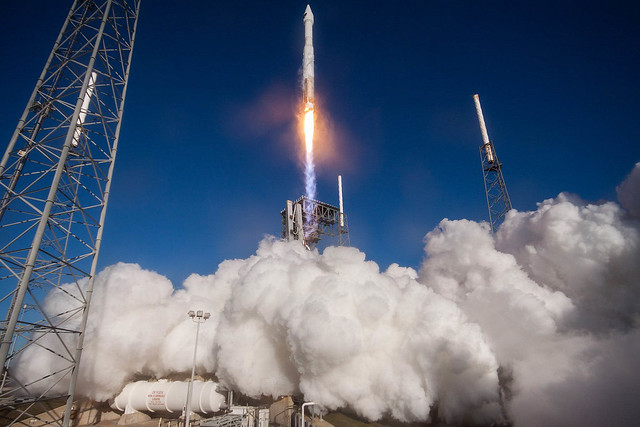
    A United Launch Alliance Atlas V rocket carrying the GPS IIF-12 mission lifted off from Space Launch Complex 41 at Cape Canaveral Air Force Station, Fla., Feb. 5, 2016. (Courtesy photo/United Launch Alliance) CC BY-NC 2.0

    Winston Beauchamp, the Deputy Under Secretary of the Air Force for Space, and the director of the Principal Defense Department Space Advisor Staff said of the USAF’s commitment, “We have an obligation to provide, not just space resiliency capabilities for our defense space, but for this global commons.”

    Thank you, Mr. Beauchamp, and your USAF colleagues, for having America’s back around the world, and in space.

    Read the complete story at AirForceTimes.com

  • D3 Space Solar Proposal

    On March 2, 2016, the Secretary of Defense, Secretary of State, and USAID director held a competition to uncover the very best ideas for improving planet Earth. Of over 500 ideas submitted, six teams were selected to present their vision for the future. The Space Solar Proposal Team won four of seven awards: Innovation, Presentation, Collaboration, People’s Choice.

    Here is the winning D3 Space Solar Proposal (D3SSP) Presentation, presented by Dr. Paul Jaffe, Electronics Engineer and Integration and Test Section Head, U.S. Naval Research Laboratory:

    Learn more about this winning proposal at the D3SSP website. There, you will be able to read about:

    • Problem Background & Potential Impact
    • The Big Idea
    • Ideal End State
    • Five Critical Next Steps
    • Proposed Metrics
    • Resource Requirements
    • The Proposal Team

    You can also join in the discussion on the D3 Space Solar Proposal Public Group on Facebook.

  • Solar Power Satellites Issue – Online Journal of Space Communication

    This Issue #16 – Solar Power Satellites is the most comprehensive set of articles I have seen in one place addressing all aspects of space-based solar power.

    “In this issue, the Journal advances the proposition that the next generation of satellite services will be to gather sun’s energy in space and to deliver it to earth as a clean and sustainable source of electrical power. In the 21st century, the need for alternatives to the burning of fossil fuels to generate electricity has become so great that space is now a real option.”

    Ralph Nansen, author of ENERGY CRISIS: Solutions from Space, and former Manager of the Solar Power Satellite Program for The Boeing Company is the guest editor for this edition of the Online Journal of Space Communication.