Category: SBSP articles

  • SBSP Article on HuffPo / Times of India

    Reaching For The Sun (fair use)

    In a March 9, 2016 article, Reaching For The Sun: Space-Based Solar Power Could Be The Answer To Climate Change, Namrata Goswami writes about the D3 Space Solar Proposal that won several top prizes for for the best ideas to advance U.S. Diplomacy, Defense and Development at the March 2, 2016 D3 Summit held in Washington, D.C.

    About the idea of space-based solar power, Goswami writes:

    Could this idea be as revolutionary as the Wright Brothers’ paper plane that gave us modern aviation? Perhaps!

    In the rest of the article, Goswami does a good job of explaining the fundamental principles behind space-based solar power, and then she goes on to talk about Japan, China, and India already being heavily invested in the development of space-based solar power.

    As noted in a 2008 C-SBSP post, 21st Century Space Race, our nation is once again behind, and once again in a position to catch up. It is a race we must lead, and if not win outright, at least cross the finish line arm-in-arm with our friends and allies.

  • Aviation Week Article on SBSP

    European Aeronautic Defence and Space Company (EADS) subsidiary Astrium is seeking to scale up ground based demonstrations by getting public agencies and corporations interested in funding an orbital demonstration project. The company is projecting having a 10-20KW demonstrator in orbit, perhaps on the International Space Station, within five years. Astrium engineers are focusing on using infrared lasers to beam the collected energy back to the surface instead of the more traditional microwave beam approach.
    This isn’t the first time Aviation Week & Space Technology has reported on space-based solar power, but it is the first time in a while and it may signify an up-tick in activities around the world.

    Read the Aviation Week article by Michael A. Taverna published in the January 25, 2010 issue here.

    I’ll make my plea once again … U.S. government agencies and private corporations must get on the space-based solar power development path soon or we will be left playing catch-up once again. It seems to me that Lockheed Martin Corporation is the perfect United States’ answer to EADS-Astrium’s efforts on the European continent.

  • SBSP on George Friedman’s Agenda

    STRATFOR’s founder and CEO George Friedman discusses the push for space-based energy infrastructure after EADS, Europe’s largest space company, announces plans to launch a test satellite with solar panels. Friedman also predicted that space-based solar power will be the planet’s primary source of energy sometime in the next 100 years in his latest book by the same title … “The Next 100 Years”.

  • Solar Power Satellites Issue – Online Journal of Space Communication

    This Issue #16 – Solar Power Satellites is the most comprehensive set of articles I have seen in one place addressing all aspects of space-based solar power.

    “In this issue, the Journal advances the proposition that the next generation of satellite services will be to gather sun’s energy in space and to deliver it to earth as a clean and sustainable source of electrical power. In the 21st century, the need for alternatives to the burning of fossil fuels to generate electricity has become so great that space is now a real option.”

    Ralph Nansen, author of ENERGY CRISIS: Solutions from Space, and former Manager of the Solar Power Satellite Program for The Boeing Company is the guest editor for this edition of the Online Journal of Space Communication.

  • Japanese Engineering Groups Join Mega Space Solar Project

    JAXA Space Solar Power System
    Source: Japan Aerospace Exploration Agency via Bloomberg

    Sept. 1 (Bloomberg) — Mitsubishi Electric Corp. and IHI Corp. will join a 2 trillion yen ($21 billion) Japanese project intending to build a giant solar-power generator in space within three decades and beam electricity to earth.

    A research group representing 16 companies, including Mitsubishi Heavy Industries Ltd., will spend four years developing technology to send electricity without cables in the form of microwaves, according to a statement on the trade ministry’s Web site today.

    An undated handout illustration (left) shows Japan Aerospace Exploration Agency’s Space Solar Power Systems (SSPS), which beams the electricity using microwaves from space through the ionosphere, the outermost layer of the earth’s atmosphere, provided to the media on Sep. 1, 2009.

    Read the rest of the article at bloomberg.com

    Perhaps I should change the name of this blog to “Citizens of the World for Space Based Solar Power!”

  • The Commercialization of Space-Based Solar Power?

    I was searching for any recent activity on Space-Based Solar Power when I simply happened on the website of Space Energy, a Swiss company with plans to commercialize the concept. Here are their Vision and Mission statements, excerpted from the Space Energy website:

    Vision statementSpace Energy, Inc. intends to become the world’s leading commercial enterprise in the field of Space-Based Solar Power (SBSP) which will improve the lives of millions of people by bringing a source of safe, clean energy to the planet.

    Mission statementTo develop, own, and operate the first SBSP satellites to provide base-load and emergency electrical power to customers around the globe at affordable, fair market prices.

    What we desperately need now is for American corporations and entrepreneurs to apply American ingenuity and start competitive efforts so that the free market forces can forge the best Space-Based Solar Power solutions for the entire planet.

    Rob Mahan
    Citizens for Space Based Solar Power

  • George Friedman on SBSP During “The Next 100 Years”

    George Friedman, founder of the private intelligence firm Stratfor, has written a book titled The Next 100 Years. In the following video summary of the book at about the 1:50 mark, Friedman predicts that space-based solar power will be one of two dominate forces that will shape global warming. He also predicts that the United States will become the major source of energy for the entire world.

  • SBSP Demonstration Satellite Project Announced

    On October 13, 2008, Colonel M.V. “Coyote” Smith publicly announced a plan to build the first-ever space-based solar power satellites. The vision of the plan is to light a single light bulb with power collected in space and beamed to Earth and the mission is to give students real-world experience working on solving the problems that lie in the path of developing and deploying Space Based Solar Power.

    This plan includes building two satellites with launch dates sometime during 2010. One would collect solar energy and beam it back to an Earth-based lightbulb and the other would carry a lightbulb into orbit which would be illuminated from an Earth-based source of wirelessly transmitted energy.

    It appears that the Air Force Academy and six other yet-to-be-publicly-announced universities will be participating in this first-of-a-kind project. I hope that Georgia Tech will be one of the universities that is heavily involved,  based on their active Space Solar Power Workshop.

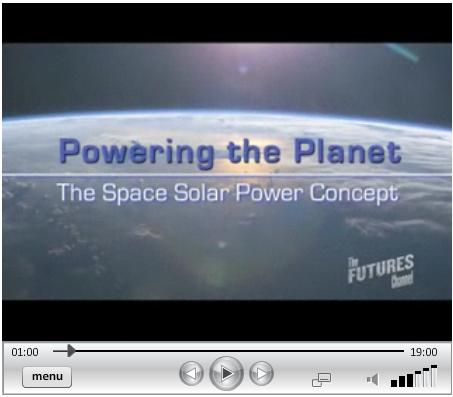
  • Powering the Planet – The Futures Channel

    The Futures Channel has produced a 19 minute video to assist teachers in helping students begin to gain an understanding of the science, technology, engineering, math, energy, policy, environmental factors, and more involved in making Space Based Solar Power a reality.  Students who are  informed will be able to participate in and influence the debate over Space Based Solar Power.

    powering_the_planet

    Source: The Futures Channel

  • 21st Century Space Race

    Then

    Sputnik by dan mogford Yuri Gagarin from NASA Repository JFK from LOC Archives Neil Armstrong by NASA

    On October 4, 1957, a few days more than a year before I was born, the Soviet Union launched the tiny Sputnik 1 into geocentric orbit around the Earth. That event effectively initiated last century’s Space Race, resulting in the rapid development of mankind’s ability to explore outer space. Yuri Gagarin’s historic first human spaceflight on April 12, 1961 further captured the imagination of America.

    Speaking to a Joint Session of Congress on May 25, 1961, President John F. Kennedy challenged our nation to land a man on the Moon and return him safely to Earth before the decade was out. Kennedy later made a speech at Rice University on September 12, 1962, in which he said “No nation which expects to be the leader of other nations can expect to stay behind in this race for space.” and “We choose to go to the Moon in this decade and do the other things, not because they are easy, but because they are hard.”

    On June 20, 1969, an Ohio farm boy named Neil Armstrong became the first human being to set foot on the Moon, saying “That’s one small step for man, one giant leap for mankind.” and effectively bringing the 20th century Space Race to a close.

    But you know all of this already.

    You probably watched a lot of this story unfold, mesmerized and huddled around a black and white television set in your family’s living room. But do you know about the 21st century’s Space Race that’s just beginning, once again with our nation behind and in a position to try to catch up? Read on …

    Now

    Solar Power Satellite ©Mafic Studios, Inc

    Published in Scientific American in July of 2008, the article Farming Solar Energy in Space states “Shrugging off massive costs, Japan pursues space-based solar arrays”. The Japanese Space Agency (JAXA) is heading up a team of over 180 scientists from various research institutes doing research in both laser and microwave based space solar power systems. “We’re doing this research for commonsense reasons—as a potential solution to the challenges posed by the exhaustion of fossil fuels and global warming,” says Hiroaki Suzuki of JAXA’s Advanced Mission Research Center.

    One of Japan’s major early goals is to have in place a one gigawatt space solar power system by 2030. They are now doing the basic science to determine if the project is actually feasible. And, according to the article, while the total cost of the project will be enormous, that does not stand in the way of laying the scientific foundation for a successful deployment.

    The questions to my fellow citizens, government and industry leaders are:

    1. Who is going to step forward and challenge our nation to embark on the research and development of space-based solar power, not because it is easy or because it is hard, but because of it’s potentially tremendous positive impact on the future of our nation and all of mankind?
    2. When will we launch the first, perhaps tiny, solar power satellite into geocentric orbit and receive the first solar energy collected in space for use on the Earth?
    3. Who will be the first American to set foot on a solar power satellite in geosynchronous orbit, transmitting gigawatts of pure, clean energy to Earth?
    4. Will we enter this 21st century Space Race at all, before it is too late? I hope so … I really do.