Category: carbon crisis

  • It’s Always Sunny in Space

    It’s Always Sunny in Space

    After listening to Can Science Save Us?, a conversation with Sir Martin Rees on the Michael Schermer Show, I wrote both Dr. Schermer and Lord Rees with the intention of telling them about space-based solar power (SBSP), which was not mentioned in the podcast. As a result, I was invited to write an article about SBSP for the current issue of Skeptic Magazine v28.2: Energy Matters. My article, ‘It’s Always Sunny in Space,’ is reprinted here with permission from Skeptic Magazine.

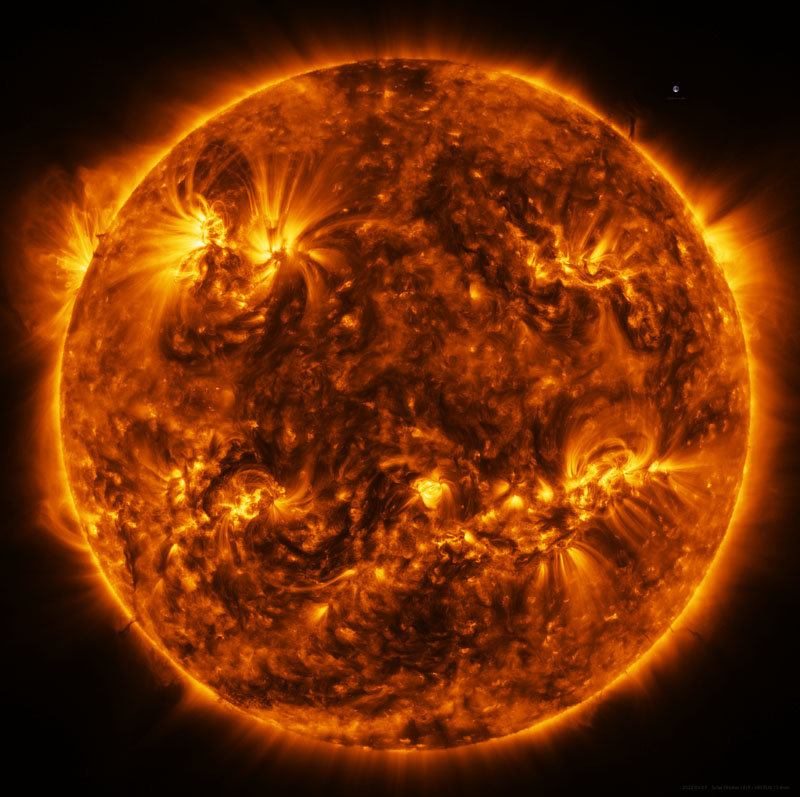
    Copyright: ESA & NASA/Solar Orbiter/EUI team; Data processing: E. Kraaikamp (ROB)

    This is the highest resolution image of the Sun’s full disc and outer atmosphere (the corona) ever taken, as seen by Solar Orbiter in extreme ultraviolet light from a distance of nearly 47 million miles. This stellar image is a mosaic of 25 photographs taken on March 7, 2022 by the high resolution telescope of the Extreme Ultraviolet Imager (EUI) instrument. An image of Earth is included for scale, in the upper right corner of the illustration.

    A tremendous thermonuclear furnace, our Sun radiates about 134,000 terawatts (TW) of continuous power to Earth’s surface, about 7000 times more than the entire population of humankind consumes from all current sources of energy.


    It’s Always Sunny in Space

    Why space-based solar power is a viable source of energy.

    by Rob Mahan

    Advances in human civilization have always been fueled by the availability of excess energy in various forms. For the vast span of human history, energy from the Sun was converted to food and biomass by photosynthesis and expended in the forms of muscle power and fire. Energy from the Sun produced weather, and as a result, wind- and water power were eventually harnessed and converted into increased levels of societal organization.

    When humans began to extract massive amounts of energy from plant-based fossil fuels—which originated millions of years ago, through photosynthesis driven by energy from the Sun—further technological complexity, economic surplus that freed increasing numbers from manual labor, and human population all exploded. Gasoline-powered, mass-produced automobiles represented freedom in the form of personal transportation. Electricity became an efficient way to deliver energy to homes and businesses, and eventually to power a global information network. Growth was good, and seemed unstoppable, at least to those with easy access to abundant energy.

    More recently, science and rationality have led us to a stark realization. Year-over-year economic growth, driven by the ever-increasing consumption of finite natural resources to produce abundant energy and other goods, has proven unsustainable. Coupled with concerns about climate change resulting from the release of excessive carbon dioxide into the atmosphere, three broad future scenarios emerge:

    • Continue the current, unsustainable trend of natural resource extraction, energy consumption, and economic growth, and let natural processes dictate the next era in human history.
    • Based on current and past technologies, voluntarily and drastically reduce global energy consumption and revert much of humankind to the previous era of muscle, wind, and water power.
    • Develop new technologies and find cleaner, renewable, or unlimited forms of abundant energy, while becoming better stewards of the finite natural resources that remain.

    If the third scenario is the most appealing to you—as it is to me—and almost all forms of energy harnessed by humankind throughout history originated with energy from the Sun, doesn’t it make sense to look directly to the source in our quest to find a clean, unlimited source of energy for all of humanity going forward?

    What does “space-based solar power” mean?

    Space-based solar power (SBSP) refers to the concept of collecting the Sun’s energy in space and then transmitting it to Earth for use as a baseload renewable energy source. This involves putting solar panels in orbit around the Earth to continuously collect energy from the Sun. The energy is transferred to receiving antennas (rectennas) on Earth as microwave or laser beams, converted to electrical energy, and then sent to consumers through the existing power distribution grid. The goal of SBSP is to provide practically unlimited clean energy that is not subject to weather conditions or night-day cycles; energy that is available 24/7/365, anywhere on the planet.

    Before we delve into the details and challenges around space-based solar power, let’s take a brief step back in time to see how humanity got where we are today, and how we may soon be consuming the equivalent amount of energy in 150 billion barrels of oil every year.

    How much energy is globally consumed by humankind?

    It took the first three million years of evolution for the world population to reach one billion of us. Over the past 220 years, fueled by advances in medicine, nutrition, and a massive glut of cheap energy from the worldwide fossil fuel industry, the world population has exploded to over eight billion humans. The United Nations estimates that the world population will expand to over ten billion by the year 2100.1 In the developing economies of emerging nations, particularly in Asia, per capita energy consumption is increasing as people seek better lives for themselves and their families.

    Driving—or driven by—economic and population growth, worldwide energy consumption also exploded over the past two centuries, and with it, energy-related carbon dioxide emissions. The Enerdata World Energy & Climate Statistics lists the 2021 global total energy consumption as 14,555 million tons of oil equivalent (Mtoe), or for comparison purposes, the equivalent of about 169,277 terawatt-hours (TWh) of electrical energy. For 2021, the global electricity generation is listed as 28,433 TWh of electrical energy, or about 16.8% of the global total energy consumption.2

    A mid-range scenario presented in the Enerdata Global Energy & Climate Outlook 2050 assumes policies that will lead to a global temperature rise between …

    Click here to read the entire article in PDF format.


  • NSS: “Dear Earth”

    Dear Earth: We’re Sorry for What We’ve Done to You…

    The National Space Society announced today its “Dear Earth” campaign for space solar power has been named in the Best of Social Media category in the 42nd Annual Telly Awards.

    https://space.nss.org/

    It has long been C-SBSP’s assertion that Earth-found fuels–carbon-based, uranium, thorium, etc.–are all finite natural resources that will one day be more costly to extract than the value of the energy they will yield. On a planetary time scale, or even the time scale of humankind, when that day comes is practically irrelevant. If we are not prepared when that day does inevitably arrive, civilization as we know it, and perhaps even the existence of humankind, will no longer be sustainable.

    To once again restate the obvious, the Sun is our virtually unlimited source of abundant, clean energy. The only question that remains is how best to harvest energy from the Sun to provide sustainable baseload power on a planetary scale. In C-SBSP’s opinion, the answer is space-based solar power (SBSP), with the following conditions:

    • SBSP development and deployment must be done with the agreement, cooperation and participation of all space-faring nations, for the common good of all humankind.
    • Given the potential century-level project timeline, conventional political cycles and economic models must be superseded.
    • SBSP must utilize off-planet manufacturing, construction and maintenance.
    • SBSP must harvest and utilize off-planet materials and resources.

  • Petition: The Space Review Article

    The Space Review online publication has published an excellent article by Mike Snead, president of the Spacefaring Institute, supporting the USA taking the lead in space-based energy. The article also encourages citizens to sign both of our petitions to send this important message to the US Congress.

    Petitioning the US to take the lead in space solar power

    Human civilization has been very fortunate to have access to readily available fossil fuels to enable the industrial revolution and the rise of our modern society. However, as most now understand, environmental and energy security concerns have emerged from our substantial use of fossil fuels.

    Two new petitions seek to generate public support for investment in space-based solar power development. (credit: Spacefaring Institute LLC)

    Our thanks to Mike Snead for his concise and compelling arguments in favor of space-based energy, and also thanks to Jeff Foust for publishing Mike’s article and helping us to get the word out to a much wider audience.

    Click here to read Mike’s entire article on The Space Review online publication website.

    Click here to read more of Mike’s writing on his Spacefaring America blog.

  • Petition: Spacefaring Institute Releases Advocacy Video

    The Spacefaring Institute has released this compelling video in support of our petition, “USA Must Lead the Transition to Space-Based Energy.”

    Please share this video and help get the word out, and please sign the petition at change.org.

  • Petition: USA Must Lead the Transition to Space-Based Energy

    Citizens for Space Based Solar Power has published the following petition, addressed to the President of the United States, the U.S. Senate, and the U.S. House of Representatives.

    Please go to change.org and sign this petition to send a strong message to the President and to Congress: Take these actions now to transition our nation and the world from dependence on fossil fuels to a virtually unlimited source of clean, sustainable energy.

    USA Must Lead the Transition
    to Space-Based Energy

    Your signature on this petition will have a very real and positive impact on the United States of America and on all future generations of humankind worldwide.

    If you doubt this statement, please read on.

    The Current Energy Problem

    The United States of America faces a looming national energy security threat due to its dependence on a finite supply of fossil fuels.

    Humankind worldwide faces an environmental security threat due to its dependence on fossil fuels that release carbon dioxide into the atmosphere when burned.

    The human desire to improve our standard of living is driving both the United States of America and humankind worldwide to consume more energy per person than ever before.

    Worldwide population growth, coupled with increasing energy consumption per person, is increasing the total amount of energy required to sustain humankind worldwide.

    There are no terrestrial energy sources, renewable or non-renewable, that can be sustainably scaled to meet the planet’s increasing energy requirements.

    The Future Energy Solution

    Sustainable, carbon emission free energy from space-based solar power (SBSP) is the solution. Simply put–and challenging to accomplish–SBSP consists of orbiting solar power satellites continuously harvesting the sun’s intense energy in space. The energy is beamed wirelessly to rectifying antennas on the Earth, and then transmitted to existing electrical power grids. Unlike terrestrial renewable energy sources, space-based solar power is nearly infinitely scalable. It is also continuous, so it can supply the planet’s baseload energy requirements.

    Space-based solar power is not a new idea. Peter Glaser, an American scientist, obtained U.S. Patent Number US003781647 for SBSP in 1973. Since then, the idea has been studied extensively by NASA, other government agencies, academic groups, private organizations, and individuals. Every technology required for the implementation of SBSP exists, and they are each well understood.

    Implementing the Future Energy Solution

    Transitioning the United States of America, and eventually, humankind worldwide, to sustainable, carbon emission free space-based energy will require a substantial, coordinated effort, sustained economic investment, and political will. Likely to span the rest of the twenty-first century, commitment to this effort must supersede the short-term nature of two- and four-year election cycles.

    *** A CALL TO ACTION ***

    Sign this petition and send the following urgent message to the United States Congress, to the President of the United States, and to future congresses and administrations:

    Pass and support legislation to ensure national energy security and to protect the worldwide environment by establishing congressionally chartered public-private corporations for space-based energy, space mining, and spacefaring logistics. These corporations shall provide the United States, its allies, and trading partners with sustainable and carbon emission free space-based energy.

    ******

    Challenges to Implementing the Future Energy Solution

    The United States of America has a proven track record of success with large and difficult challenges, like building a transcontinental railroad, building a national highway system, and creating an extremely successful communications satellite industry.

    In 1957, the Soviet Union successfully launched Sputnik I. The following year, the U.S. Congress passed the Space Act and created NASA. In 1961, John F. Kennedy challenged our nation to claim a leadership role in space and land a man on the moon within the decade. In July of 1969, the Apollo 11 spaceflight landed Americans Neil Armstrong and Buzz Aldrin on the Moon. The Apollo Program went on to send ten more astronauts to walk on the Moon.

    Today Japan, China, and India all have active space-based energy development programs.

    The main challenges to implementing a successful space-based energy industry can be categorized in three areas.

    Technical Challenges

    • Several viable space-based energy concepts have been proposed. The concept for implementation must be downselected through scientific experimentation and prototype testing.
    • The safety of space-based energy, with respect to people, animals, and the environment, must be demonstrated through scientific experimentation and prototype testing.
    • Launch costs to place the required mass of solar power satellites into orbit must be reduced to improve the business case for space-based energy.
    • Advances in commercial launch capabilities, material sciences, robotic assembly methods, and other related technologies must continue to improve the business case for space-based energy.

    Economic Challenges

    • The economic effort to implement space-based energy will be substantial, likely requiring a small but significant fraction of the U.S. Gross Domestic Product (GDP) to be invested. Initially, a return on that investment will come in the form of new industry and job creation, and spinoff technologies.
    • Sustained investment will likely be required for the remainder of this century.

    Political Challenges

    • The commitment to implement space-based energy will likely span the rest of this century. This long-term commitment must supersede the short-term nature of two- and four-year election cycles.
    • A decision must be made as to whether the United States of America will solely take on the challenge of implementing space-based energy, or whether the United States of America will lead a coalition of our allies and trading partners in this effort.
    • Public opinion must be rallied to support the technology of space-based energy, and the economic and political commitments required for its successful implementation.
    Resources for Learning More About Space-Based Energy

    This is only a small portion of the available space-based energy resources, presented in no particular order. Additional Google and YouTube searches are highly recommended.

    D3 Space Solar Proposal – 2016 multi-agency proposal for the U.S. to begin a space-based solar power program

    Spacefaring Institute – Dedicated to transforming America into a true, commercial spacefaring nation

    Space Solar Power Institute – A non-profit corporation organized to educate the public about space solar power

    Space Solar Power Workshop at Georgia Tech – A volunteer workshop researching the details of space solar power

    National Space Society – Space Solar Power Resources – A curated library of space solar power related books, articles, studies, websites, videos, and other resources

    The Case for Space Solar Power – 2014 book by John C. Mankins that recounts the history of space-based solar power and lays out a path forward for its implementation

    Citizens for Space Based Solar Power – A space-based solar power advocacy blog, with the goal of educating fellow citizens and influencing public opinion in favor of this game-changing technology


    *** ONCE AGAIN, A CALL TO ACTION ***

    Sign this petition and send the following urgent message to the United States Congress, to the President of the United States, and to future congresses and administrations:

    Pass and support legislation to ensure national energy security and to protect the worldwide environment by establishing congressionally chartered public-private corporations for space-based energy, space mining, and spacefaring logistics. These corporations shall provide the United States, its allies, and trading partners with sustainable and carbon emission free space-based energy.

  • SBSP – A Solution to the Carbon Crisis

    Can space-based solar power solve the carbon crisis? The business model in this video shows how SBSP could be scaled to meet planetary energy needs with zero carbon emissions.

    • The business model presented was developed by Keith Henson.
    • The video was produced by Mafic Studios, Inc.
    • The script was written by Lt. Col. Peter Garretson, Keith Henson, and Kris Holland.
    • Narration was done by Jay Aaseng.