Category: future energy needs

  • Astroelectricity: America’s national energy security imperative

    Astroelectricity: America’s national energy security imperative

    by Mike Snead

    Here’s a summary of “Astroelectricity: America’s national energy security imperative” by Mike Snead (The Space Review, September 22, 2025). You can read the full article here. Learn more about Mike at The Spacefaring InstituteTM here.

    Conclusions

    Snead argues that space solar power–supplied astroelectricity is the only sustainable energy solution that is both large enough and practicable enough to enable America to replace its fossil carbon energy sources before depletion and avoid returning to energy insecurity. The scale of the energy transition is enormous, and only with strong government leadership, research, and early deployment of SSP can the U.S. ensure an orderly transition. To maintain national energy security, and protect future generations, Snead believes the development and deployment of astroelectricity must now be viewed as a strategic imperative.

    Main Points

    • The U.S. currently depends heavily on fossil fuels: oil, natural gas, and coal supply about 70–80 Quads of the ~100 Quads of primary energy consumption as of 2019.
    • Technically recoverable oil and gas in the U.S. may last ~75 years at 2019 consumption levels, but with exports and growing use, the lifetime could be much shorter.
    • To transition (“go clean”) to sustainable energy, two criteria are key: (1) sufficient scale, and (2) a practicable, orderly implementation. Political or symbolic solutions will not suffice.
    • Of all sustainable energy sources, only a few are scalable to entirely replace fossil carbon fuels: intermittent wind, intermittent ground solar, baseload nuclear fission, and baseload space solar power (SSP), i.e. “astroelectricity.”
    • Assessment of wind power: Even if large areas are used, in average years wind might supply ~68 % of the needed intermittent power; in low wind years that drops sharply; public/land-use acceptance is a major constraint.
    • Ground solar farms: To meet the intermittent power need would require ~14 % of the U.S. contiguous land area—much of which overlaps with prime agriculture or unsuited terrain.
    • Nuclear fission: To supply all baseload power would require many times current nuclear capacity; breeder reactors bring proliferation risks; decommissioning, waste, natural disasters, and terrorism risks also loom large.
    • Astroelectricity (SSP): Collect sunlight in geostationary orbit, convert to electricity, beam to earth via radio/microwave, received by large rectenna farms. Supplies baseload power. Requires only a small fraction of U.S. land compared to terrestrial-only options.
      • For example: to supply ~80 % of baseload power via astroelectricity, about 4,339 GW continuous (GWc) would be needed from SSP, requiring ~182,000 km² land for rectenna/plant sites—< 3 % of the contiguous U.S. land area.

    Glossary of Terms Used

    • BTU (British Thermal Unit)
      A unit of thermal energy defined as the amount of heat needed to raise one pound of water by one degree Fahrenheit. 1 BTU ≈ 1,055 joules. Used to measure the energy content of fuels like coal, oil, and natural gas.
    • BOE (Barrel of Oil Equivalent)
      A unit that expresses energy content in terms of a barrel of crude oil. One BOE = 5.8 million BTU of thermal energy. Useful for comparing different fuels on a common basis.
    • Quad (Quadrillion BTUs)
      A large-scale unit of energy equal to 1 quadrillion (10^15) BTUs. Commonly used to describe national energy consumption. For example, in 2019, the U.S. used about 100 Quads of primary energy.
    • GW (Gigawatt)
      A measure of power equal to 1 billion watts (10^9 W). Often used to describe the size of power plants or electricity generation capacity.
    • GWc (Gigawatts Continuous)
      A refinement of GW, meaning gigawatts of continuous power output, i.e., power delivered around the clock without interruption. Used to describe baseload capacity requirements for astroelectricity.
    • Technically Recoverable Resources
      The portion of identified oil, gas, or coal reserves that can be produced with existing technology and practices, regardless of market price.
    • Primary Energy
      Energy found in natural resources (like coal, oil, natural gas, wind, sunlight) before being converted into electricity, fuels, or heat for use by consumers.
    • Baseload Power
      The minimum level of continuous power demand that must be met by an energy system. Technologies that can deliver baseload (like nuclear or space solar power) are especially valuable for energy security.
    • Rectenna
      A large ground-based receiving antenna that converts microwave or radio wave transmissions from space solar power satellites back into usable electricity.
  • It’s Always Sunny in Space

    It’s Always Sunny in Space

    After listening to Can Science Save Us?, a conversation with Sir Martin Rees on the Michael Schermer Show, I wrote both Dr. Schermer and Lord Rees with the intention of telling them about space-based solar power (SBSP), which was not mentioned in the podcast. As a result, I was invited to write an article about SBSP for the current issue of Skeptic Magazine v28.2: Energy Matters. My article, ‘It’s Always Sunny in Space,’ is reprinted here with permission from Skeptic Magazine.

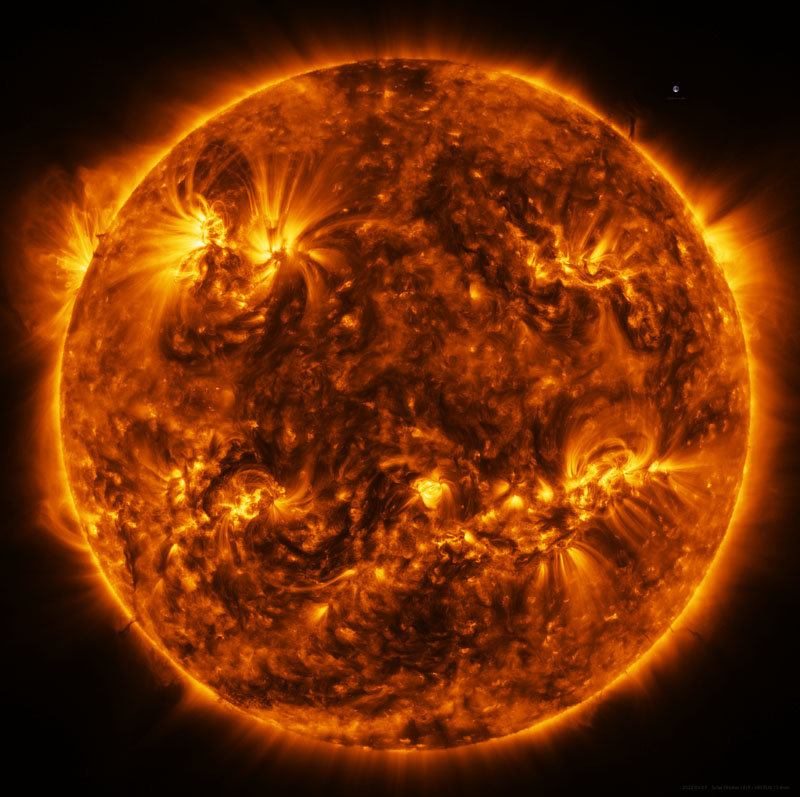
    Copyright: ESA & NASA/Solar Orbiter/EUI team; Data processing: E. Kraaikamp (ROB)

    This is the highest resolution image of the Sun’s full disc and outer atmosphere (the corona) ever taken, as seen by Solar Orbiter in extreme ultraviolet light from a distance of nearly 47 million miles. This stellar image is a mosaic of 25 photographs taken on March 7, 2022 by the high resolution telescope of the Extreme Ultraviolet Imager (EUI) instrument. An image of Earth is included for scale, in the upper right corner of the illustration.

    A tremendous thermonuclear furnace, our Sun radiates about 134,000 terawatts (TW) of continuous power to Earth’s surface, about 7000 times more than the entire population of humankind consumes from all current sources of energy.


    It’s Always Sunny in Space

    Why space-based solar power is a viable source of energy.

    by Rob Mahan

    Advances in human civilization have always been fueled by the availability of excess energy in various forms. For the vast span of human history, energy from the Sun was converted to food and biomass by photosynthesis and expended in the forms of muscle power and fire. Energy from the Sun produced weather, and as a result, wind- and water power were eventually harnessed and converted into increased levels of societal organization.

    When humans began to extract massive amounts of energy from plant-based fossil fuels—which originated millions of years ago, through photosynthesis driven by energy from the Sun—further technological complexity, economic surplus that freed increasing numbers from manual labor, and human population all exploded. Gasoline-powered, mass-produced automobiles represented freedom in the form of personal transportation. Electricity became an efficient way to deliver energy to homes and businesses, and eventually to power a global information network. Growth was good, and seemed unstoppable, at least to those with easy access to abundant energy.

    More recently, science and rationality have led us to a stark realization. Year-over-year economic growth, driven by the ever-increasing consumption of finite natural resources to produce abundant energy and other goods, has proven unsustainable. Coupled with concerns about climate change resulting from the release of excessive carbon dioxide into the atmosphere, three broad future scenarios emerge:

    • Continue the current, unsustainable trend of natural resource extraction, energy consumption, and economic growth, and let natural processes dictate the next era in human history.
    • Based on current and past technologies, voluntarily and drastically reduce global energy consumption and revert much of humankind to the previous era of muscle, wind, and water power.
    • Develop new technologies and find cleaner, renewable, or unlimited forms of abundant energy, while becoming better stewards of the finite natural resources that remain.

    If the third scenario is the most appealing to you—as it is to me—and almost all forms of energy harnessed by humankind throughout history originated with energy from the Sun, doesn’t it make sense to look directly to the source in our quest to find a clean, unlimited source of energy for all of humanity going forward?

    What does “space-based solar power” mean?

    Space-based solar power (SBSP) refers to the concept of collecting the Sun’s energy in space and then transmitting it to Earth for use as a baseload renewable energy source. This involves putting solar panels in orbit around the Earth to continuously collect energy from the Sun. The energy is transferred to receiving antennas (rectennas) on Earth as microwave or laser beams, converted to electrical energy, and then sent to consumers through the existing power distribution grid. The goal of SBSP is to provide practically unlimited clean energy that is not subject to weather conditions or night-day cycles; energy that is available 24/7/365, anywhere on the planet.

    Before we delve into the details and challenges around space-based solar power, let’s take a brief step back in time to see how humanity got where we are today, and how we may soon be consuming the equivalent amount of energy in 150 billion barrels of oil every year.

    How much energy is globally consumed by humankind?

    It took the first three million years of evolution for the world population to reach one billion of us. Over the past 220 years, fueled by advances in medicine, nutrition, and a massive glut of cheap energy from the worldwide fossil fuel industry, the world population has exploded to over eight billion humans. The United Nations estimates that the world population will expand to over ten billion by the year 2100.1 In the developing economies of emerging nations, particularly in Asia, per capita energy consumption is increasing as people seek better lives for themselves and their families.

    Driving—or driven by—economic and population growth, worldwide energy consumption also exploded over the past two centuries, and with it, energy-related carbon dioxide emissions. The Enerdata World Energy & Climate Statistics lists the 2021 global total energy consumption as 14,555 million tons of oil equivalent (Mtoe), or for comparison purposes, the equivalent of about 169,277 terawatt-hours (TWh) of electrical energy. For 2021, the global electricity generation is listed as 28,433 TWh of electrical energy, or about 16.8% of the global total energy consumption.2

    A mid-range scenario presented in the Enerdata Global Energy & Climate Outlook 2050 assumes policies that will lead to a global temperature rise between …

    Click here to read the entire article in PDF format.


  • Energy from Outer Space: A SSP Course on Udemy.com

    This is the first of several course preview videos available at
    https://www.udemy.com/course/space-solar-power/

    The course author, John Clarkson, contacted me through C-SBSP to make me aware of this online course about space-based solar power. I have purchased the course and completed the 1-1/2 hours of included lectures on a broad range of SBSP-related topics. Many other learning resources are also included.

    I have concluded that this course would be worthwhile to anyone seeking a solid introduction into the following topics from the course outline:

    • Space Based Solar Power (SBSP)
    • How SBSP works
    • What are its major advantages and drawbacks of SBSP?
    • Which nations are developing SBSP and why?
    • An idea of what it costs to get SBSP into orbit
    • Rockets, how they work, with some mathematics
    • Orbital mechanics and how this is relevant to SSP
    • Wider future market opportunities for SBSP, including direct and indirect markets both new and to be developed
    • Why SBSP will be an investment in the future
    • SBSP weapons – Are they feasible? Can we make them safe?
    • A wider knowledge of the economics of energy and how SBSP can change it

    Energy from Outer Space on Udemy.com

    Read more about the course author, John Clarkson, along with this and other related courses at his website, Future of Energy College.

  • China: The Long March 9 and Long Term Planning

    President Kennedy Addresses Congress May 25, 1961
    (Photo from NASA Commons on Flickr)

    China plans to use a new super heavy-lift rocket currently under development to construct a massive space-based solar power station in geostationary orbit.

    by Andrew Jones in June 28, 2021 Space News

    The American four-year political cycle dissipates tremendous amounts of energy and opportunity like so much waste heat. Right, wrong or indifferent, when the first acts of every new administration are to undo the efforts of the previous administration in some made-for-television show of power and bravado, truly important projects like space-based solar power (SBSP), which require long-term planning and commitment, may literally never get off the ground for the citizens of the United States.

    Without the authority to enter into international treaties, the private sector probably can’t implement SBSP on its own. Without the incentive to plan and execute outside of the four-year political cycle, the government probably can’t implement SBSP on it’s own.

    Does logic suggest that a public-private partnership will be required to develop and implement SBSP for Americans? Do we have to rely on Congress to create that partnership? Spurring Congress to that meaningful action might fall on the shoulders of all Citizens for Space Based Solar Power.

    Read the full Space News article:
    China’s super heavy rocket to construct space-based solar power station

  • NSS: “Dear Earth”

    Dear Earth: We’re Sorry for What We’ve Done to You…

    The National Space Society announced today its “Dear Earth” campaign for space solar power has been named in the Best of Social Media category in the 42nd Annual Telly Awards.

    https://space.nss.org/

    It has long been C-SBSP’s assertion that Earth-found fuels–carbon-based, uranium, thorium, etc.–are all finite natural resources that will one day be more costly to extract than the value of the energy they will yield. On a planetary time scale, or even the time scale of humankind, when that day comes is practically irrelevant. If we are not prepared when that day does inevitably arrive, civilization as we know it, and perhaps even the existence of humankind, will no longer be sustainable.

    To once again restate the obvious, the Sun is our virtually unlimited source of abundant, clean energy. The only question that remains is how best to harvest energy from the Sun to provide sustainable baseload power on a planetary scale. In C-SBSP’s opinion, the answer is space-based solar power (SBSP), with the following conditions:

    • SBSP development and deployment must be done with the agreement, cooperation and participation of all space-faring nations, for the common good of all humankind.
    • Given the potential century-level project timeline, conventional political cycles and economic models must be superseded.
    • SBSP must utilize off-planet manufacturing, construction and maintenance.
    • SBSP must harvest and utilize off-planet materials and resources.

  • Power Beaming & Space Solar Innovation by Dr. Paul Jaffe, PhD

    Move energy, not mass.

    This hour-long presentation by Dr. Paul Jaffee, PhD, of the U.S. Naval Research Laboratory on July 30, 2020 is a comprehensive look at the past, present and future of power beaming and space based solar power. Power beaming is an integral part of space based solar power, and also has standalone terrestrial and space-based applications.

    This video was livestreamed by the Homeland Defense & Security Information Analysis Center (HDIAC). The original podcast and links to additional resources highlighted by Dr. Jaffe may be found at:

    https://www.hdiac.org/podcast/power-beaming/

  • Moon to Mars – We Are Going

    Fifty years after the Apollo program propelled the first humans to the Moon, NASA’s Artemis program is a plan to return us to the Moon. This time, we will stay, in orbital and surface outposts. The knowledge and resources gained in these outposts will fuel humankind’s next giant leap – sending astronauts to Mars.

    NASA programs spin off technologies that enter and improve our Earthbound lives. I believe the Artemis program will spin off space mining, space manufacturing, and other technologies that will support America’s capabilities to develop and implement scalable and sustainable space-based solar power.

    As Citizens for Space Based Solar Power readers know, I believe that space-based solar power is the only viable replacement for fossil fuels that will supply global energy needs as we move into the 22nd century and beyond.

  • Forbes.com article – SBSP should be a national priority

    “Trump Should Make Space-Based Solar Power A National Priority”
    by Bruce Dorminey, contributor, Forbes.com

    Image Credit: NASA

    In a recent Forbes.com article, science journalist and author Bruce Dorminey argues for the current administration to make development and deployment of space-based solar power a national priority. Read the full article here.

    If President Trump were to champion space-based solar energy as a means of delivering unlimited, renewable electricity from Earth orbit, it’s arguable that his administration could leave the U.S. and the world at large with a revolutionary new source of energy.

    In this advocate’s opinion, one of the most important points Dorminey makes is that ” … the fledgling space-based solar power initiative needs cohesive leadership to actively plot goals and transform it into a workable industry.” The majority of SBSP supporters have thus far focused on engineering challenges, essential to the technical “how is it done” question of space-based solar power. Two other questions, the financial “who pays for it” and the political “who gets the credit or takes the blame” must also be answered for a complete solution.

    With most complex problems, the level of difficulty usually increases from the technical solution to the financial solution to the often intractable political solution. A current, complex problem to illustrate this three-pronged approach might be the ongoing battle over national healthcare. (Have even one of the three questions truly been answered yet?)

    To jumpstart a U.S.-led space-based power agenda, at least three in-depth proposals for federal legislation have already been put forward:

    SunSat Corporation Charter – proposed by the Space Solar Power Institute’s (SSPI) Space Solar Power Workshop, led by Darel Preble at Georgia Tech

    Space Review article: Federal Legislation to Jumpstart Space Solar Power – written by Mike Snead, President, the Spacefaring Institute

    D3 Space Solar Proposal – Diplomacy, Development, and Defense (D3) Innovation Summit Pitch Challenge award-winning proposal by a team of scientists led by Dr. Paul Jaffe, spacecraft engineer at the U.S. Naval Research Laboratory (NRL)

  • Use Your Fame for Good, Ken Bone

    Kudos to my wife, Linda, for suggesting that I contact Ken Bone and let him know about space-based solar power, the serious long-term clean answer to his excellent energy policy question at the recent presidential debate.

    kenbone18

    With 163k and counting new Twitter followers, a retweet by Ken would be a real public service!